
Jesse Sweeten spent nearly a decade doing industrial construction along the Gulf Coast — gas plants, chemical facilities, work that paid well but came with real risk and no certainty about what came next. When he moved to Austin and heard the city was at the center of a semiconductor boom, he didn’t know how to get in. Then he found Merit America.
Here’s how Jesse translated the skills he’d already built into a career at Samsung — while working full-time, without a four-year degree, and with a paid training program at Tesla already lined up next.
A Career Built on Real Skills — with a Real Ceiling
Jesse had been good at his work for a long time. Since 2014, he’d traveled the Gulf Coast as an industrial pipe fitter, maintaining systems at gas and chemical plants. Along the way, he built a specific and serious set of skills: reading and following safety protocols in hazardous environments, maintaining and troubleshooting mechanical and fluid systems under pressure, working with precision in high-stakes settings, and doing it all while coordinating with large crews across constantly changing job sites.
Those aren’t soft skills. They’re the exact foundations that advanced manufacturing environments are built on.
The problem wasn’t his capability. It was the structure of the work itself.
“You show up to work not knowing if you’re going to go home that day,” he said. “The money’s great. But if you have a family, you’re not wanting to travel — and you respect that you have good health and you don’t want that to change.”
Contract-to-contract industrial construction meant never quite knowing where the next job would be, how long it would last, or what the path forward looked like. Jesse wasn’t stuck because he lacked skills. He was stuck because the field he was in couldn’t give him what he was actually after: stability, growth and the ability to build something over time in one place.
After relocating to Austin, he started noticing a different kind of opportunity. The city was filling up with semiconductor companies. Samsung, Tesla and a growing network of suppliers were all expanding. People he met talked about it like it was the beginning of something that wasn’t going away.
He didn’t know how to get in. But he was paying attention.
Then a Merit America ad appeared on Facebook — the Semiconductor and Advanced Manufacturing Career Track. He clicked.
“When I saw Merit America offering classes on it,” Jesse said, “I was like — this is something that could work for me.”
Why His Background Was A Good Fit
When Jesse enrolled, he was also working as a facilities technician at Comico, a semiconductor parts-cleaning company in Austin. His role there involved maintaining robotics, troubleshooting clean-room systems and responding when equipment went down. It wasn’t semiconductor manufacturing in the strict sense — but the overlap was real.
“It’s directly related to the courses I was taking,” he said. “Just kind of indirectly my responsibility.”
That’s the thing about skilled trades backgrounds that doesn’t always get named clearly: the technical fluency transfers. Understanding how systems fail and why. Knowing how to read a physical environment, follow safety protocols without being reminded and work carefully around equipment that can’t be forced. Those instincts don’t have to be rebuilt from scratch in a semiconductor clean room — they just have to be redirected.
What the program gave Jesse wasn’t a replacement for what he already knew. It was context, language and credential. The ability to walk into an interview at Samsung and explain not just what he’d done, but what it meant for the role they were hiring for.
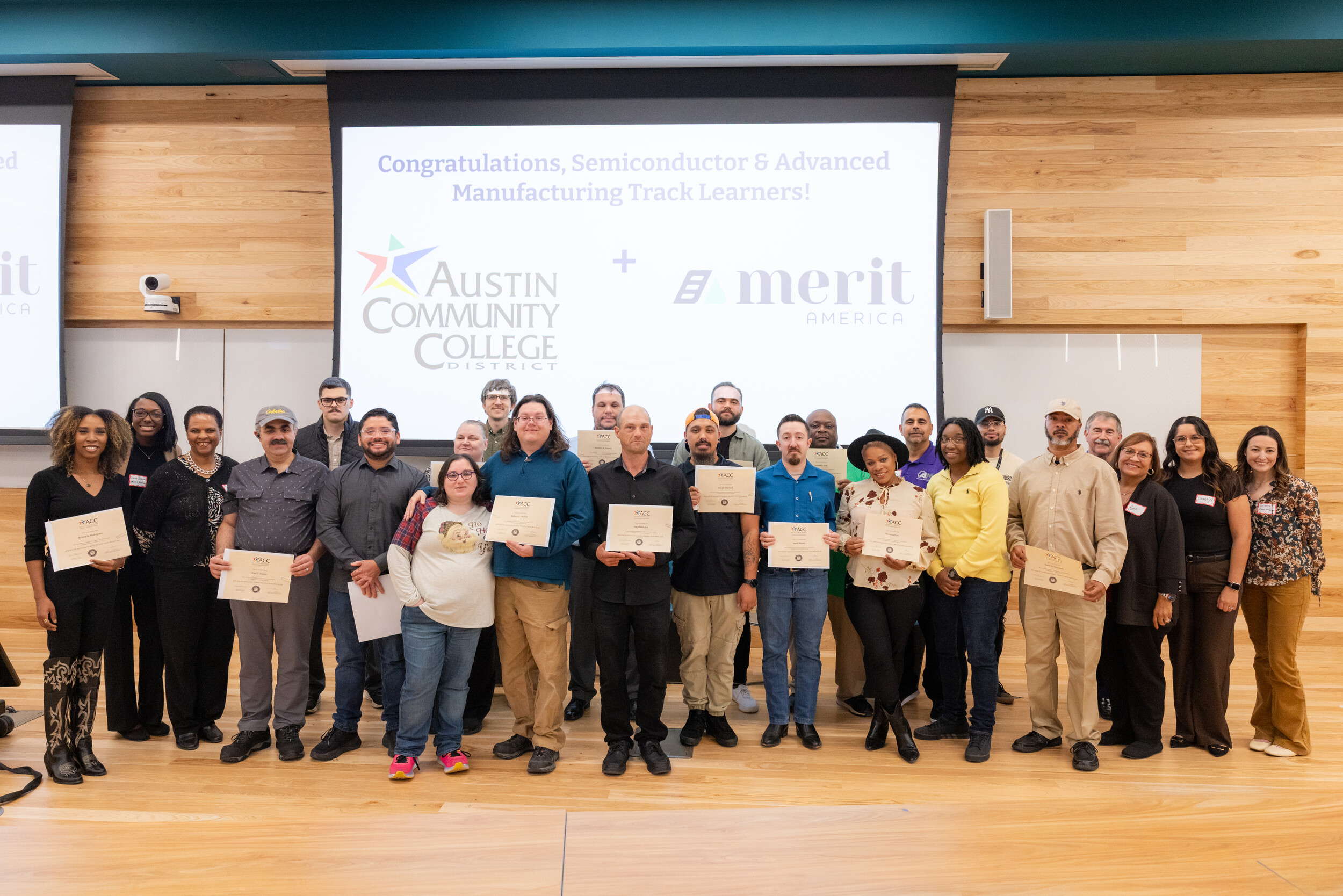
Here’s a closer look at what the 14-week program actually covers — and why it landed well for someone with Jesse’s background:
Safety and compliance fundamentals — OSHA protocols, hazard communication, PPE, lockout/tagout (LOTO) and electrical safety. Jesse had lived versions of all of this in industrial construction. The semiconductor context formalized it.
Manufacturing materials and processes — material properties, fabrication, assembly and testing. Different materials than pipe fitting, same underlying logic of understanding what you’re working with and why it behaves the way it does.
Production management and lean principles — 5S methodology, production metrics, inventory management. New content for Jesse, but built on the same systematic thinking that makes a good trades worker.
Hands-on lab days at ACC — four full in-person days at Austin Community College’s facility, covering cleanroom procedures, electronics, pneumatics and soldering. VR learning and hands-on simulations alongside direct instruction. Not a classroom exercise — actual exposure to the environment he’d be walking into.
Résumé, job search and career coaching — the piece that connected everything else. How to present the experience he had in the language the industry uses.
ACC’s Advanced Manufacturing Production program is the first in the country to receive the SEMI Foundation’s Fundamental Semiconductor Knowledge Certification — the industry’s gold standard for entry-level workforce training. Jesse didn’t just complete a program. He earned a credential that carries weight with the exact companies hiring in Austin.
Learning Without Losing Everything Else
One of the most practical things about Jesse’s story is that it didn’t require him to stop.
The program runs about 20 hours a week — online coursework done flexibly around a working schedule, with four required in-person lab days built in. Jesse kept his job at Comico throughout. He kept providing for himself and his family. He didn’t have to choose between training and living.
“With a lot of different schooling, you’ve got to either take away time from your job or your family,” he said. “That’s not the case with Merit America. It’s been really easy to show up for the in-class labs and complete the assignments without it really putting a damper on my day-to-day life.”
He brought a friend from Corpus Christi into the program with him. They drove to ACC together for labs, worked through the coursework side by side and kept each other moving.
“Normally with programs like this, they fill up quick or you don’t get the chance to share another opportunity with someone else,” Jesse said. “With Merit America, I was able to connect with my friend all the way in Corpus and he got in with me.”
The Coaching That Made the Difference
Technical readiness gets you to the interview. Coaching gets you through it.
Jesse’s career coach, Sabrina — Merit America’s dedicated Semiconductor Career Coach in Austin — worked with the cohort throughout the program. She connected learners with recruiters, ran job search workshops, helped build and refine résumés and made sure the whole cohort understood not just what they’d learned, but how to talk about it.
“Sabrina demonstrated expert coaching in regards to getting us in touch with recruiters and job placement,” Jesse said. “We were able to take our résumés and make them where they’re almost perfect. The amount of effort that’s been put into this is great.”
There was something else the coaching addressed that Jesse hadn’t anticipated going in. He didn’t just need credentials for semiconductor roles. He needed to know they existed.
“Without Merit America, I wouldn’t have known these jobs existed,” he said. “Not only that, I probably wouldn’t have had the basic information to understand what it was that I was applying for. But being able to see things and relay information — that’s what opened up the door for me at Samsung. Just having that understanding: okay, this is something I could do.”
This is the part of career change that gets underestimated. The skills gap is real, but it’s closeable. The bigger obstacle is often the visibility gap — not knowing which roles exist, what they pay, what they actually require day-to-day, or how a background like yours connects to them. Closing that gap is exactly what the coaching in the program is built to do.
What He Walked Away With
By the time Jesse completed the program, he had built something concrete:
- An industry-recognized credential — ACC’s Occupational Skills Award, certified by the SEMI Foundation
- A résumé that translated his trades experience into semiconductor manufacturing language
- A direct network of Austin-area hiring partners through Merit America and ACC
- Hands-on lab experience in cleanroom procedures, electronics, pneumatics and soldering
- The vocabulary to explain his own skills to employers who didn’t know his background
None of those existed before the program. All of them mattered to what came next.
Landing at Samsung
After completing the program, Jesse secured a new career at Samsung as an Automatic Material Handling System (AMHS) installer. He works directly inside the semiconductor manufacturing facility, installing the tracking systems that move materials through production. Clean-room work. Semiconductor manufacturing at one of the biggest names in the industry. In Austin, where the jobs are.
“It’s super interesting,” he said. “It’s very new to me, but it is at its core semiconductor-related.”
The distance from pipe fitter to Samsung AMHS installer looks large on paper. In practice, it was a series of connected steps. Jesse had the mechanical foundation. The Merit America program gave it context, credential and direction. The coaching gave him the ability to present it clearly. And Austin’s semiconductor boom meant that when he showed up ready, there were doors to walk through.
What Comes Next
Jesse isn’t stopping at Samsung.
Through Merit America’s relationship with Tesla, he was also accepted into the Tesla MVP (Manufacturing Vocational Program) — a paid, seven-week, full-time program that provides advanced manufacturing training and a direct pathway to employment at Tesla. Full benefits. Forty hours a week in the classroom, compensated.
“Who wouldn’t be excited for paid schooling?” Jesse said. “I’ve done college before and it gets expensive. To have someone say, ‘hey, we’re going to pay you to come sit in a classroom and learn something new’ — that’s amazing.”
The Tesla program was visible to his cohort from the beginning of Merit America — introduced at the first session as something learners could work toward. That early visibility mattered.
“At the beginning you’re like, wow — not only am I having this education, but there’s also a chance for a career at the end,” he said. “There’s a light at the end of the tunnel.”
Beyond Tesla, Jesse has his eye on continuing his education at ACC — potentially toward a bachelor’s degree, and eventually an engineering credential.
“I think at this point, if I can go back to ACC and get a bachelor’s and maybe even look toward an engineering degree, I think that would be huge,” he said. “I won’t have to worry about anything. I’ll be able to make the amount of money that’s needed to maybe retire eventually.”
For someone who built a career on moving from contract to contract, never quite knowing where the next one would land, that kind of horizon is the whole point.
“This is a place I could potentially retire and not have to worry about traveling, not have to worry about finding another job,” he said. “This is it.”

Three Things Jesse’s Story Shows About Career Change
His journey reflects patterns that show up across many successful career transitions — and they’re worth naming clearly for anyone considering a similar move.
- Your existing skills are more transferable than they look. Jesse walked into semiconductor manufacturing with years of safety training, systems maintenance and precision mechanical work. Those didn’t disappear when the industry changed — they became the foundation for something new. Most people underestimate how much of what they’ve already built carries forward.
- The biggest barrier is often visibility, not capability. Jesse didn’t know these careers existed until he found Merit America. The visibility gap — not knowing what roles are out there, what they pay or why your background connects to them — is often a bigger obstacle than the skills gap itself. Closing it doesn’t take years. It takes the right program and the right coaching.
- Stability isn’t a small thing to want. Wanting a career you can build over time, in one place, without wondering what comes next — that’s a legitimate and serious goal. Jesse was clear about what he was after, and he built toward it deliberately. That clarity is itself a skill.
Why the Semiconductor Field Is the Right Bet Right Now
Jesse’s path reflects a broader shift happening across the country. The CHIPS and Science Act directed $52.7 billion toward U.S. semiconductor manufacturing — and Austin is at the epicenter of that investment, with Samsung, Tesla and a growing network of suppliers actively hiring.
Approximately 60% of new semiconductor manufacturing careers will not require a four-year college degree, according to the Semiconductor Industry Association’s 2026 Workforce Policy Blueprint. The U.S. faces a projected shortfall of 59,000 to 146,000 engineers and technicians by 2029 as new fabs move from construction into full production. Entry-level manufacturing technicians earn a median salary of $57,100 — with a projected 11% growth rate over the next decade.
The opportunity is documented and growing. The question is who’s positioned to step into it.
“The Sky’s the Limit”
When Jesse reflects on how his sense of his own career has changed, he returns to something simple.
“I’m able to see myself with a little bit more value, a little bit more understanding of who I am as a person — especially in regards to the workforce,” he said. “I’m not limited by the work I used to do or the things I’ve done in the past. Merit America helped me realize that if you want to learn, it’s not too late. There are resources, there are people, there are companies out there that are willing to get you the information you need to be successful.”
He knows where he’s going. He knows it’s further than where he is now. And he knows the skills that got him here are the same ones that will get him there.
“As new doors open,” he said, “the sky’s the limit as far as how far I want to take it.”
His advice to anyone on the fence: move.
“Just do it — because at the end of the day, you miss 100% of the shots you don’t take. This program can change everything for you in the blink of an eye. All it takes is a little bit of motivation, which you have.”
Ready to Write Your Own Story?
Jesse’s path started with a single click on a Facebook ad. Yours might start here.
Merit America’s Semiconductor and Advanced Manufacturing Career Track is a 14-week hybrid program based in the Austin area — online coursework you complete around your current schedule, with four in-person lab days at ACC. You don’t need prior manufacturing experience. You don’t need a four-year degree.
Entry-level manufacturing technicians in this field earn a median salary of $57,100, with a clear trajectory toward $77,000 at mid-level and $95,000 at senior level. The program fee is $0 for qualified Central Texas residents, made possible through employer partners and program funders.
If you complete the program and don’t land a career paying $40,000 or more within two years of your program end date, you may be eligible for a full refund. That’s the Merit America Guarantee.
Not sure if this is the right track? The Career Track Quiz takes about two minutes and matches your background to the program with the strongest fit.
Or see how Merit America works →
📌 Related Reading:
- What Is the Semiconductor and Advanced Manufacturing Career Track? — A full breakdown of the program, what you’ll learn and the careers it prepares you for.
- Best Careers to Start at 30 (No Degree Needed) — Semiconductor manufacturing alongside the fastest-growing, most accessible careers in 2026.
- More Learner Stories — Alumni across every track who made the move.